
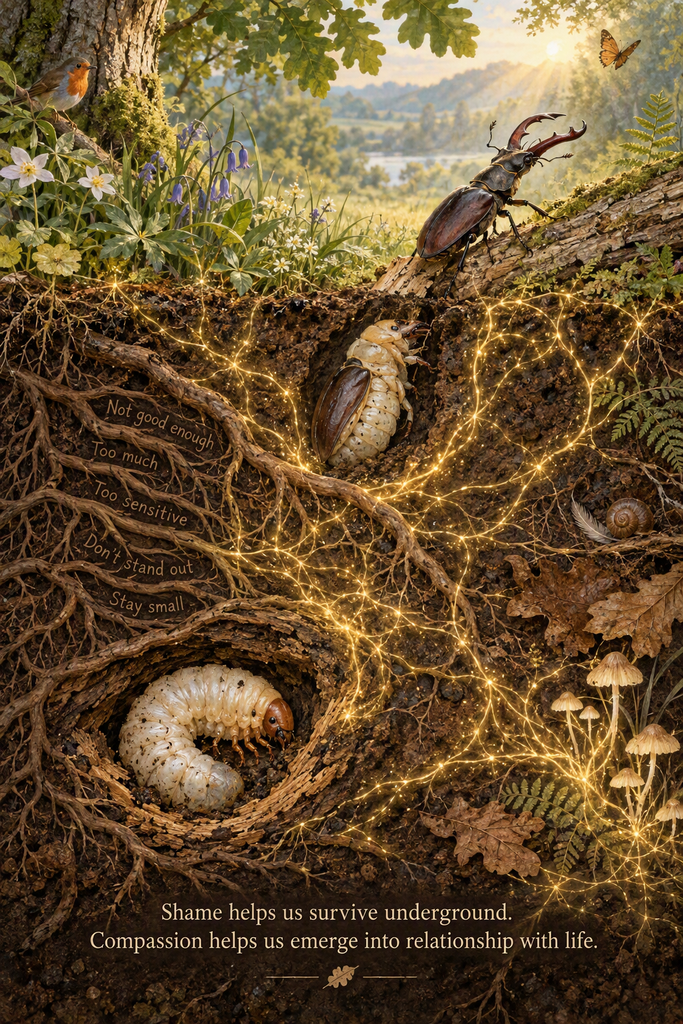
So, what can shame teach us about surviving, belonging, and ultimately coming home to ourselves? The answer may lie beneath the forest floor, where a stag beetle larva lives an invisible life.
For years it remains hidden in the darkness, feeding quietly inside decaying wood. It does not fly. It does not dazzle. Nor does it reveal itself to the world. Instead, it stays buried, protected by layers of earth and timber.
To an outside observer, this hidden existence might seem restrictive. Yet the larva is not broken.
It is surviving.
And in many ways, shame operates in much the same way.
We often think of shame as a problem to be solved, a distortion to be corrected, or a negative belief to challenge. We tell ourselves, or others, “You have nothing to be ashamed of.”
Yet shame rarely loosens its grip through logic alone.
That’s because shame isn’t primarily a story.
It’s a state.
How Shame Hides Us from Ourselves
Long before shame becomes a thought, it is experienced in the body. We feel ourselves contract. Inward, the shoulders curve. Our gaze drops. Our chest tightens. We become smaller. We hide. Connection feels too difficult to maintain. The connection we withdraw from can be a out-of-control parent stripping us of our dignity, a person who constantly puts us down, or someone we depend on who is emotionally unavailable.
Shame blossoms when we are publicly humiliated, mocked, teased, or exposed. Our whole body and nervous system learn: “Visibility is dangerous,” and we become those who avoid speaking up, being creative, taking risks, or expressing our authentic selves for fear of not being good enough.
Like the larva retreating into wood and soil, shame pulls us underground.
And it does so for a reason.
Why Shame Exists: An Ancient Survival Strategy
Many people see shame as evidence that something is wrong with them. But neuroscience and evolutionary psychology tell a different story.
Shame is not a design flaw.
It is an ancient survival strategy.
For hundreds of thousands of years, humans depended upon belonging to a group. Exclusion from the tribe could mean danger, starvation, or death. Our nervous systems therefore evolved sophisticated mechanisms to detect threats to connection and belonging.
Shame became one of those mechanisms.
When we sensed that we might be criticized, rejected, exposed or cast out, shame encouraged us to make ourselves smaller, quieter and less visible. It restricted our behavior in an attempt to protect our place within the group.
In other words, shame was never trying to hurt us.
It was trying to keep us safe.
The child who develops shame is not weak. The child is loyal.
Shame often arises because the child protects the relationship by sacrificing their own innocence. Rather than concluding, “My caregiver cannot meet my needs,” they conclude, “There must be something wrong with me.”
The burden of shame becomes the price of preserving attachment.
Just as the stag beetle larva remains concealed underground until conditions are right, shame creates a protective enclosure around vulnerable parts of ourselves.
The problem is that what once helped us survive can later prevent us from fully living.
When Protection Becomes a Prison
The challenge with shame is that the protective shelter eventually becomes a prison.
Our ideas go unspoken.
Silently, we suppress our needs.
Behind closed doors, we hide flaws.
We avoid risks.
We shrink our dreams.
The nervous system continues to use yesterday’s survival strategy even when today’s reality no longer requires it.
We find ourselves living inside what can feel like a tiny box.
Safe perhaps.
But not free.
Shame’s paradox is that while it seeks to protect connection, it often creates disconnection. We withdraw from the very relationships that could help us heal.
And because shame tells us that something is fundamentally wrong with us, we often become ashamed of our shame.
The protective strategy turns against itself.
Why Compassion Heals Shame Better Than Logic
Imagine trying to coax the hidden larva from its shelter by shouting into the ground.
“No need to hide!”
“Come out!”
“You’re perfectly safe!”
Those words may be true, but they are unlikely to change the beetle’s behavior.
Its survival system needs more than information.
It needs safety.
The same is true for us.
When shame is activated, the thinking parts of the brain are often no match for the body’s protective response. Insight alone rarely reaches the places where shame lives.
What does reach those places is something far more powerful.
Compassion.
Empathy.
Warm, attuned presence.
When another person meets our struggle without judgment, the nervous system begins to receive a different message:
You’re accepted.
You are not alone.
You do not need to hide here.
Compassion creates the conditions in which shame can relax its grip.
Not because it is defeated.
But because it is no longer needed.
Emerging from Shame into Connection
Eventually, the stag beetle undergoes a remarkable transformation.
The hidden creature beneath the soil becomes something entirely different. With wings it has never used before, the creature enters the open world.
It does not emerge because someone argued it out of hiding.
It emerges because the conditions for transformation have been met.
The timing is right.
The environment is supportive.
The process has unfolded naturally.
Healing from shame follows a similar path.
We do not force ourselves out of shame through criticism, analysis or willpower. We emerge gradually through experiences of compassion, empathy and connection.
As our nervous system discovers greater safety, the box begins to expand.
Our posture changes.
Our voice returns.
Curiosity replaces self-protection.
Life energy starts to flow again.
We become more visible to ourselves and others.
A Different Relationship With Shame
Perhaps the goal is not to wage war against shame.
Perhaps the invitation is to become curious about it.
To see it not as evidence of weakness, but as a faithful, if outdated, protector.
When shame appears, we might gently ask:
Tell me what you aim to protect.
What danger are you anticipating?
What would help this part of me feel safe enough to emerge?
Because shame is not the end of the story.
Like the stag beetle hidden for years beneath the forest floor, there is more to us than what is concealed.
Beneath every contraction, every urge to disappear, and every tiny box shame builds around the heart, there remains an innate longing to connect, belong and thrive.
The journey is not about forcing ourselves into the light.
It is about receiving enough empathy, compassion and safety that emerging becomes possible.
And when it does, we discover that the very thing we were trying so hard to hide was never something to be ashamed of at all. It was simply a vulnerable part of ourselves waiting for the right conditions to come home.